
Blog
Indian Factory Workers Are Training the Robots That Will Replace Them

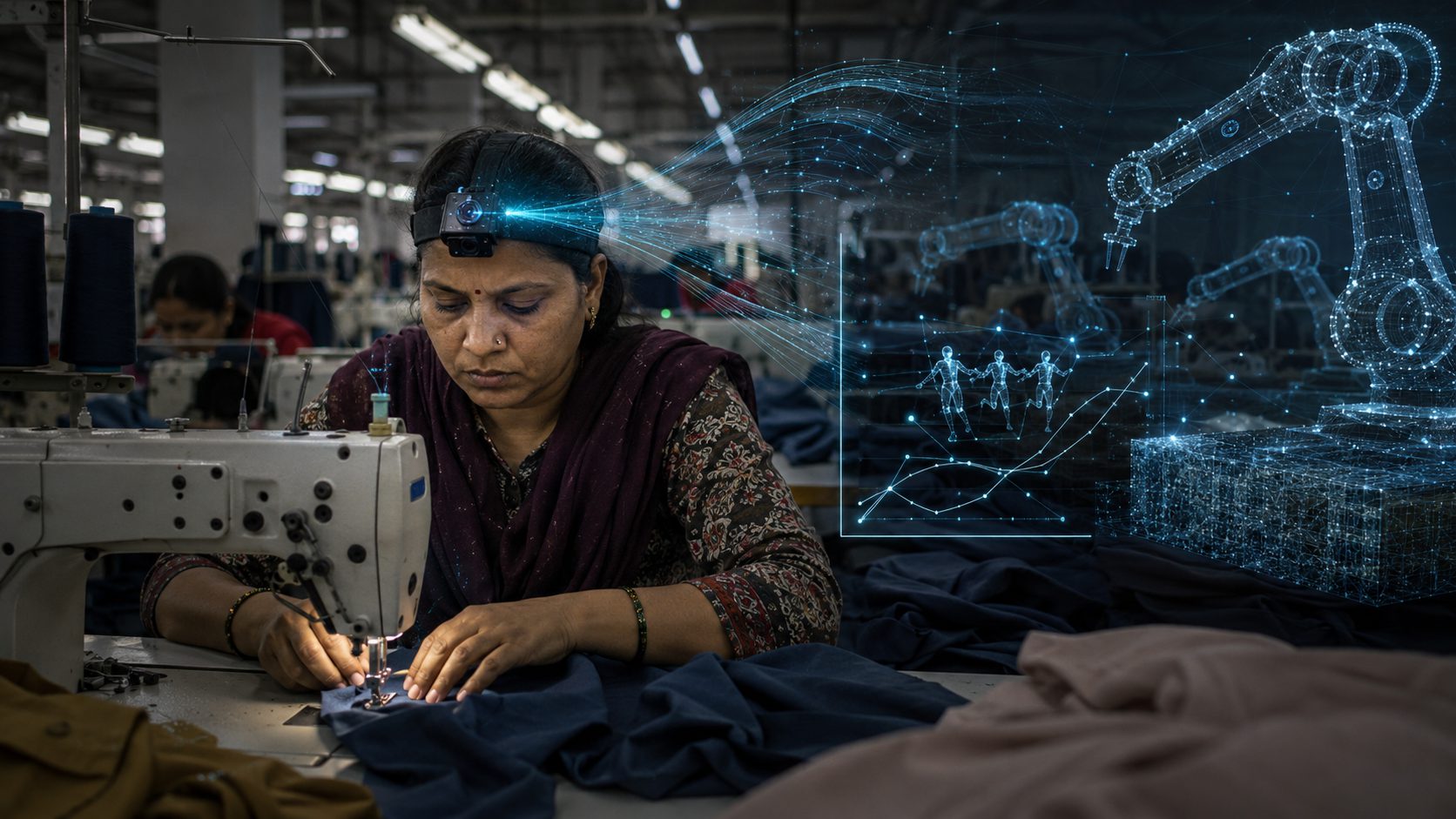
A garment worker in Delhi sits under fluorescent light, head-mounted camera strapped on, stitching fabric. That footage isn’t for quality control. It’s training data — first-person video feeding directly into the robotics systems most likely to automate her job. According to Economic Times reporting, robotics labs may need 100 million to 1 billion hours of this kind of footage over the next two to three years. India, with its massive manufacturing workforce and low collection costs, has become the primary source.
The Data Pipeline No One Told You About
Wearable cameras on factory floors are generating a new kind of AI fuel — and workers aren’t always told what it’s worth.
The footage is called egocentric data: first-person video from body-worn cameras that teaches AI to learn physical tasks from a human perspective. It powers Vision-Language-Action models — systems that combine what they see, what they’re told, and how to move. Think of it as an AI watching over your shoulder, memorizing every motion.
The economics are stark. Data collection that reportedly costs around $30 an hour in the US runs for less than one-sixth that in India, according to Economic Times reporting. Some workers are paid roughly $1 per hour, per TechCrunch reporting on Human Archive.
In cases documented by the Guardian, garment workers near Delhi received no separate compensation for the footage at all. Key issues included:
- Consent was obtained through factory management — not from workers directly.
- The cameras captured private conversations, bystanders’ faces, and sensitive workplace behavior.
- Workers weren’t always told what would be recorded.
Researcher Madhumita Dutta argues that workers may be generating a “valuable digital asset” without understanding how it will be used or monetized. In workplaces where employment is insecure, saying no to a camera isn’t really an option. These practices are part of a broader pattern of Tech Scandals in which vulnerable populations bear the costs of technological advancement without sharing in its rewards.
Who Owns the Movement?
The data starts in a worker’s body, but once extracted, it belongs to someone else entirely.
Sarayu Natarajan frames the tension precisely: the data originates in a worker’s body and actions, but once captured, it detaches from them completely. When AI companies trained models on musicians’ voices after the 2023 Hollywood strikes, the royalty debate was immediate. Here, the raw material is a garment worker’s hands. That conversation hasn’t caught up yet.
This practice extends far beyond textile factories. Construction workers, delivery drivers, street vendors, and home-services laborers are reportedly being filmed too — echoing how tech giants have approached skilled trades labor pipelines in other contexts.
India spent two decades as the internet’s back office. Now it’s becoming the body double for robots.
The central question remains unanswered: should workers share in the long-term value their movements create? Policymakers haven’t even begun defining the rules.